WHY WE NEED UGLINESS! An Essay on Ian Haig’s Work
People keep asking the same museum-shop question, the one that arrives wearing perfume and a lanyard: Why do you need to make such an ugly image? Why this horror? It’s a question that pretends to be moral but is superficial. It assumes beauty is the default setting and ugliness is an ethical deviation. It assumes images should soothe, decorate, and reassure us that the world (and our bodies) are basically fine. But almost nobody asks the opposite, the question that has teeth:
Why do you need to make a beautiful image? Why do you need the image to behave? Why do you need the cliché that sells: the clean, legible fantasy that slides frictionlessly into the feed?
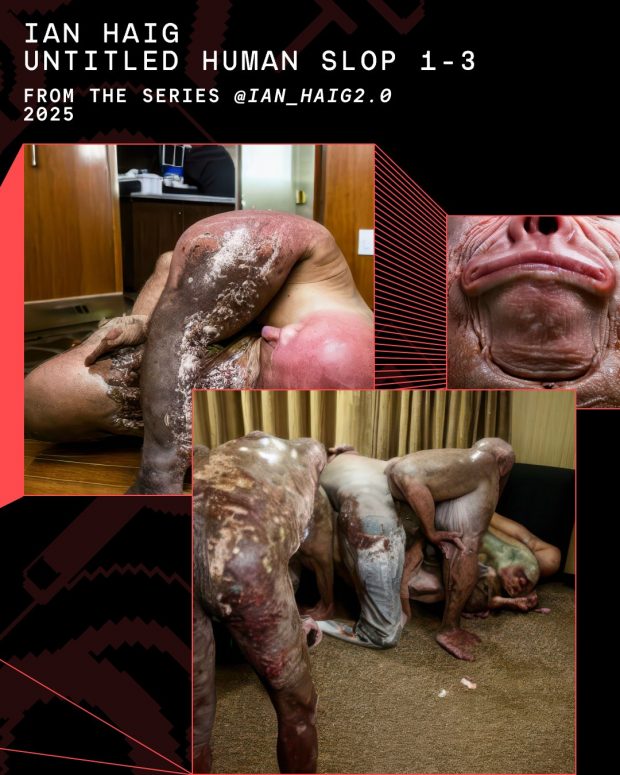
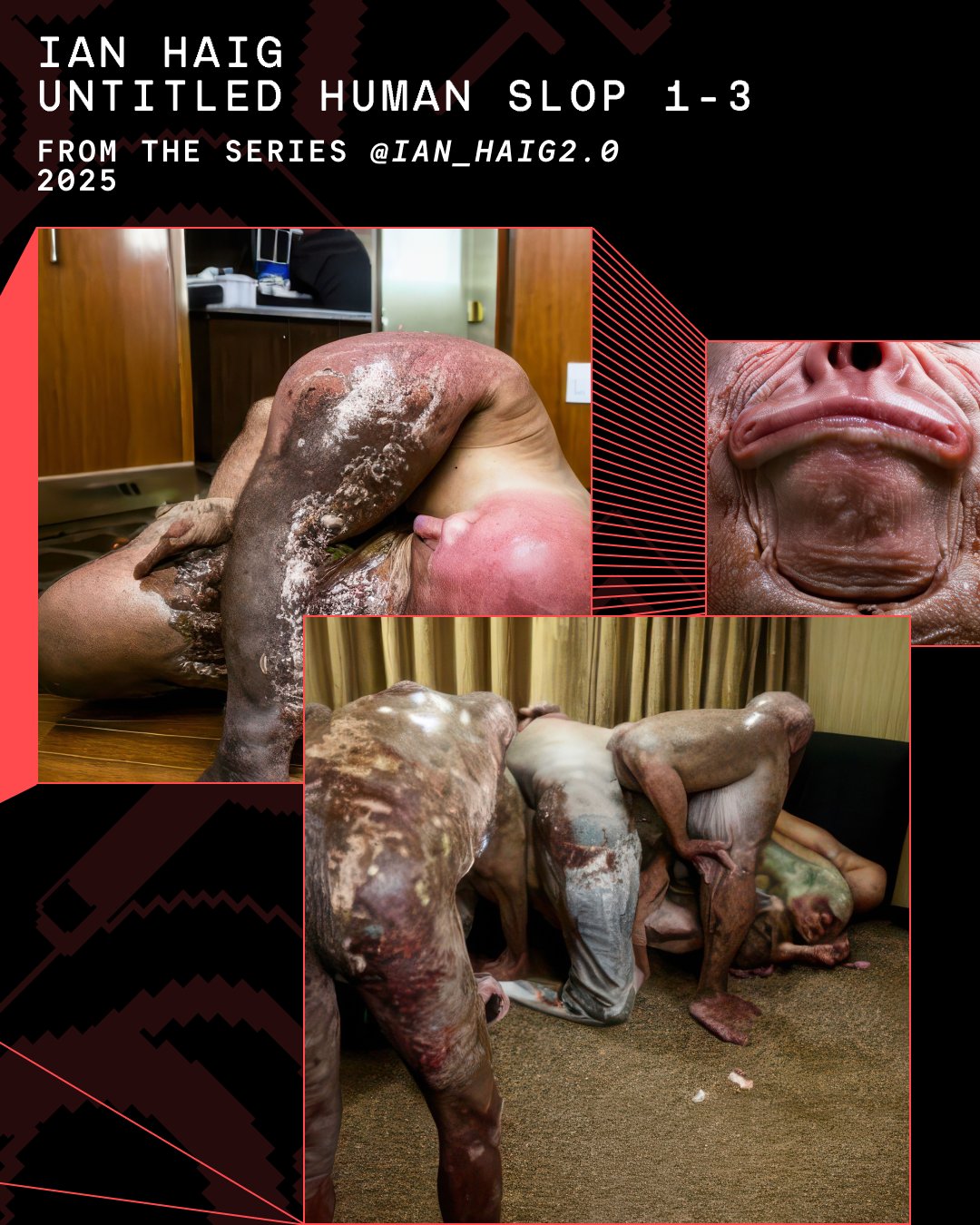
Ian Haig’s work lives inside that reversal. His “Untitled human slop 1–3” (2025) doesn’t offer the viewer a polished future-human, the corporate transhumanist poster child with perfect skin and perfect intention. It offers something closer to a leak. A spill. A malfunction. Bodies that don’t “work out,” bodies that can’t be filed into the familiar categories, bodies that have been hybridized: flesh and code stitched together by a system that can imitate everything except responsibility. He’s not painting the utopia of enhancement like most AI artists. Ian is showing the botched prototype we prefer not to imagine, the moment when the upgrade turns into an accident. And the accusation “ugly,” “horror,” “why?” is precisely the point. Haig’s images are not begging to be liked. They are refusing the social contract of the image economy: be attractive, be shareable, be instantly understood. In a culture where the beautiful image is often just a compliant interface for desire, Haig asks what happens when the image stops performing wellness. Because beauty, in 2026, is rarely innocent. Beauty is a workflow. Beauty is a preset. Beauty is a monetization strategy. Beauty is what the platform rewards: the body as brand, the self as surface, the skin as billboard. Beauty is frequently the costume that makes control look like choice. We call it “aesthetic,” but it cancels anything that reminds us we are made of meat, leakage, decay, error.
Haig’s answer is to go straight to the abject: the turned-inside-out body, the diseased body, the grotesque body. Not because he’s trying to shock you for sport, but because he’s aiming at the place where contemporary image culture is most brittle. He’s using AI (specifically the mutant, mistake-prone versions and degraded platforms he prefers)—as a pressure test. When the model “gets it wrong” (extra limbs, distorted anatomy, melted faces), it doesn’t just reveal a technical limitation. It reveals a psychological truth: the system mirrors back what we keep training into it – our obsessions, our repetitions, our idealizations, our exhausted fantasies – and then it misfires in ways that feel like dreams with bad teeth. This is why “AI slop” matters in his language. It is a symptom of the present: the endless churn where meaning gets diluted into style. The social media feed becomes a digestive tract, always swallowing, always excreting. In that sense, his grotesque bodies are honest: they look like what the image economy does to bodies. It consumes them, optimizes them, sells them, and then discards the remainder.
So, when someone says, “Why make horror?” I want to ask: Have you looked at the beautiful images lately? The beautiful images are full of horror, just with better lighting. The horror is outsourced and retouched. The horror is the pressure to be perfect. The horror is the promise that you can upgrade your way out of mortality. The horror is the quiet agreement to treat the body as a product that should never show its seams.
Haig refuses that. He insists on seams. They remind us that the body is not a clean interface. It’s a sack of processes: digestion, sweating, shedding, salivating, bleeding, aging. This is where his “ugliness” becomes a form of care. Not comforting care, more like surgical care. The kind that hurts because it refuses denial. Because the demand for beauty is often the demand for amnesia. Make it pretty so I don’t have to think. Make it pretty so I can keep scrolling. Make it pretty so I can mistake consumption for experience.
Haig breaks that spell. His images don’t let you forget the body. They don’t let you forget that the future is being built by systems that want you legible, optimizable, and above all: smooth. Ask yourself: Why do we need beauty as anesthesia? Why do we need clichés that sell as proof that we’re alive? Why do we demand that images reassure us, when reality doesn’t? Haig’s work answers by refusing the cosmetic lie. It gives us the inverse of the selfie-perfect exterior: the inside-out, the malfunction, the abject truth, monsters as evidence.
And maybe the ugliest thing here isn’t the image. Maybe it’s our need for the beautiful one.
Berlin, April 2026
Written for The AI Art Magazine
Ian Haig: https://ianhaig.net